The Productivity Tax Nobody Notices: Quantifying the Cost of Poor Indoor Air
Abstract: Organisations invest heavily in productivity tools, training, and workplace design, but often ignore the indoor environment. This article explains how poor air can become a hidden productivity tax and why even small changes in workplace effectiveness matter financially.
Every organisation understands productivity in theory.
Teams are given software. Workflows are reviewed. Office layouts are redesigned. Meeting formats are changed. Leadership training is introduced. Dashboards are built. Employees are encouraged to collaborate, focus, innovate, and perform.
Yet one of the most basic productivity conditions is often ignored: the air people breathe while they work.
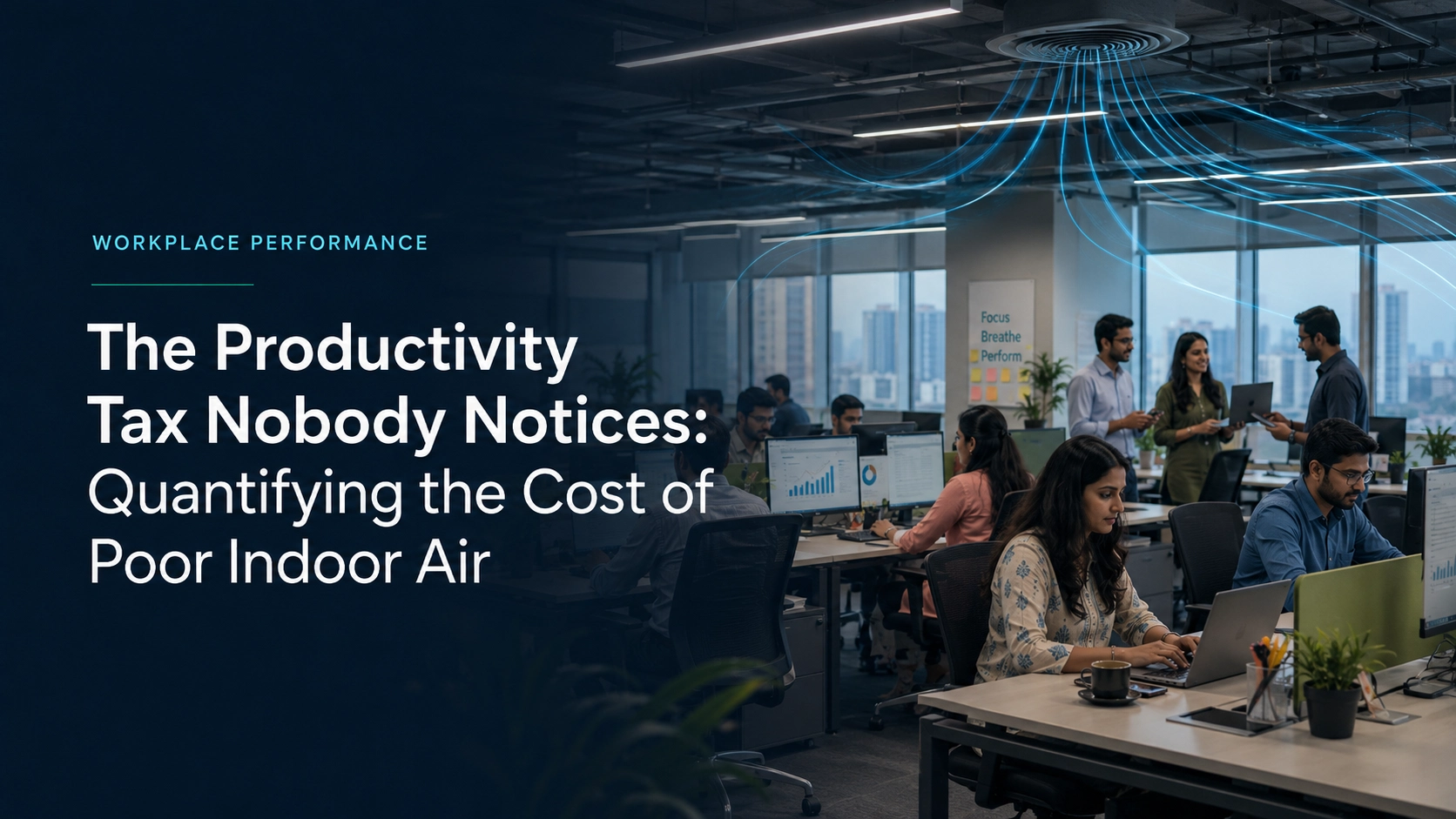
Poor indoor air rarely appears as a line item in company accounts. It does not arrive as an invoice. It does not look like a machine breakdown or a server outage. The office continues to function. People attend meetings. Work gets done.
But the loss hides inside the day. People feel tired earlier. Meetings become slower. A room feels heavy after an hour. Employees complain of stuffiness or poor concentration. Some avoid certain rooms. Others assume that afternoon fatigue is normal.
This is the productivity tax nobody notices.
Why is poor air difficult to price?
Poor air does not affect everyone in the same way. Some people may experience fatigue. Others may feel discomfort. Some may not notice consciously but may still feel less fresh by the end of the day. The impact depends on the person, the task, the room, the time of day, and the overall workplace environment.
That makes it easy to dismiss. If the internet fails, work stops. If the AC fails, people complain immediately. If lighting is poor, the problem is visible. But if ventilation is weak, the effect may be gradual.
The loss is not complete failure. It is reduced effectiveness. And reduced effectiveness, distributed across a workforce and accumulated over months, is a real cost even if it never appears on a balance sheet.
This is why indoor air quality needs to be measured. Without measurement, poor air remains a matter of opinion. With measurement, it becomes a workplace performance variable.
Why do buildings prioritise energy over air quality?
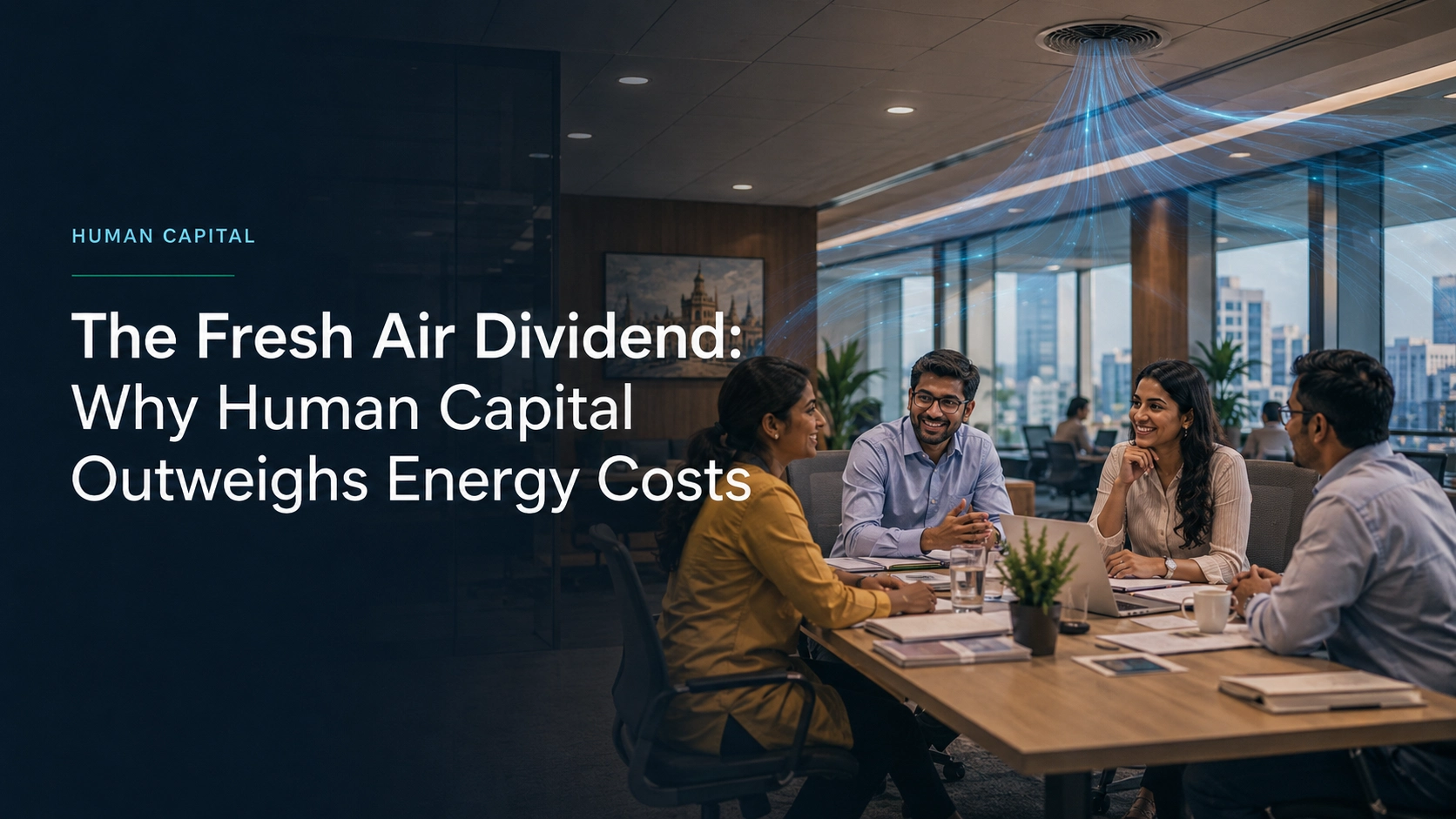
Most office buildings make ventilation decisions through an energy lens. Fresh air must be cooled, filtered, moved, and sometimes dehumidified. This has a cost. In warm and humid climates — and most of India’s major commercial centres qualify — the cost is even more visible.
But for most offices, energy is not the largest cost. People are.
Salaries, benefits, hiring, retention, training, management time, and lost productivity usually outweigh utility bills by a significant margin. In a typical 200-person office in Chennai or Bengaluru, annual people cost at conservative estimates is fifty to one hundred times the annual electricity bill. That means even a fractional improvement in the conditions that support human performance can be economically meaningful.
A building that saves energy but leaves occupants tired, uncomfortable, or dissatisfied is not truly efficient. It has simply shifted cost from the electricity bill to human performance — and hidden it there.
What does research tell us about air quality and office performance?
Harvard researchers studying real-world office conditions found that PM2.5 and CO₂ levels commonly found in conventional indoor environments were associated with meaningful changes in cognitive function among office workers — including measures of focus, task completion, and response time. The study is notable because it was conducted in actual offices, not a laboratory.
A separate large-scale analysis by Lawrence Berkeley National Laboratory examined the relationship between ventilation rates and sick building syndrome symptoms, finding a consistent pattern: as ventilation rates increased, symptom prevalence decreased. The effect was observed across multiple building types and climates.
The responsible interpretation is not that better air guarantees a fixed productivity increase. It does not. The practical interpretation is that indoor air quality is not neutral. It can support or weaken the conditions under which people think, decide, and collaborate.
How do you calculate the cost of poor indoor air?
Consider a 200-person office. If each person’s annual fully loaded cost — salary, benefits, infrastructure, management overhead — is in the range of ₹8–15 lakh, the total people cost of that office is ₹160–300 crore per year. Even a 1% reduction in effective working conditions represents ₹1.6–3 crore of economic drag annually.
This is not a precise calculation. Productivity is not linear. But the principle matters: organisations should not compare IAQ investment only against energy cost. They should compare it against the value of the people occupying the building.
The question is not: “How much does fresh air cost?” The better question is: “What does poor air cost us in comfort, attention, and workplace effectiveness?”
Why is the meeting room the right place to test this?
Meeting rooms are where poor air becomes easiest to observe and easiest to fix.
A room is booked for a review. Ten people enter. The room is cold. The screen works. The discussion begins well. After an hour, people become quieter. Someone opens the door. Someone asks if the AC can be adjusted. A few people start checking phones. The meeting ends, but the quality of attention has deteriorated.
No one records this as an air quality issue. But if this pattern repeats in the same room across different teams and different topics, the room itself is the variable. In our assessments of commercial office buildings, back-to-back-booked meeting rooms are among the most consistently under-ventilated spaces in the building. CO₂ from one group carries into the next session. The second and third groups of the day begin in air already used by the first.
What do employee complaints about the office environment actually signal?
Employees may not use technical language. They may say:
- “This room feels heavy.”
- “I feel sleepy after meetings.”
- “The office feels stuffy by afternoon.”
- “I prefer working from home.”
- “There is no freshness inside.”
These comments should not be dismissed. They are often early signals that the building needs a structured IAQ review. For companies trying to bring people back to offices, indoor comfort is not a minor detail. A workplace that feels fresh and well-managed builds trust. A workplace that feels stale weakens the case for coming in.
Why do HR, finance, and facilities need to share the same IAQ conversation?
IAQ sits between facilities, HR, finance, sustainability, and leadership. When the conversation remains only technical, the business case may be missed. When it is only about wellness, the operational solution may be weak. When finance sees only energy cost, the value of human comfort is ignored.
The strongest IAQ strategy brings these perspectives together — not as a committee exercise, but as a shared understanding that air is a workplace infrastructure issue, not a facilities nicety.
What should be measured first?
The smarter approach is to establish a baseline. Organisations should measure:
- CO₂ in meeting rooms and work areas
- Temperature and relative humidity
- PM2.5 and PM10 where dust or filtration concerns exist
- VOCs where enclosed rooms, cleaning chemicals, interiors, or equipment may contribute
- Occupancy patterns and room usage frequency
- Fresh air pathways and filter condition
- Occupant feedback, structured and periodic
The goal is to identify where the productivity tax is most likely to occur. Measurement prevents guesswork — and prevents spending money in the wrong places.
FAQs
Does poor indoor air directly reduce productivity?
It is more accurate to say that poor indoor air can weaken the conditions that support productivity, including alertness, comfort, focus, and meeting quality. The relationship is real but not mechanically linear.
Why is IAQ a finance issue?
Because people usually cost far more than energy. In most offices, salaries and benefits outweigh utility bills by a large multiple. Even small improvements in the conditions that support effective work can have economic value.
Should offices increase fresh air continuously?
Not necessarily. The better goal is appropriate fresh air based on occupancy, usage, filtration, humidity, and energy discipline. The objective is not maximum fresh air — it is right-sized fresh air.
What is the first step?
Start with IAQ measurement across representative rooms and work zones. Baseline before spending. Then prioritise corrective actions by zone.