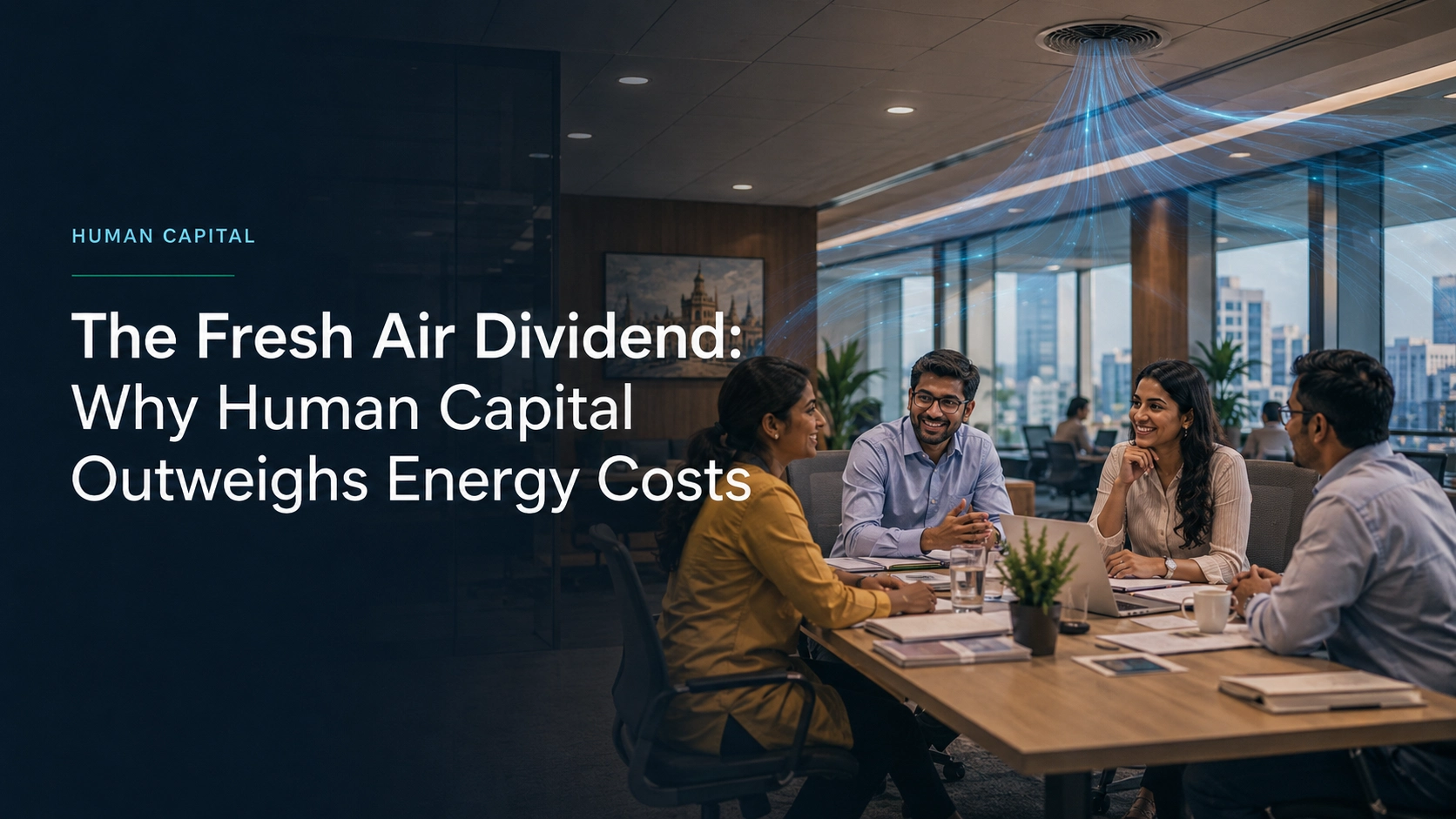
IAQ Has an ROI: The Business Case for Fresh Air
Abstract: Fresh air has a cost, but poor air has a cost too. This article presents a business case for IAQ that includes energy efficiency, targeted capex, workplace comfort, occupant confidence, and ESG credibility — with a practical five-layer framework for evaluating return on investment.
Indoor air quality is often discussed only when something goes wrong. A room smells strange. Employees complain of stuffiness. A meeting room feels heavy. A certification requirement asks for fresh air calculations. A sensor is installed and the numbers are suddenly uncomfortable.
Until then, air is assumed. This is why IAQ is often underfunded. It is invisible when it is working and difficult to value when it is not measured. Electricity has a bill. Rent has a contract. Software has a dashboard. Air quality often has only complaints.
Yet indoor air quality has a return on investment — and to understand it, organisations must move beyond the narrow question: “What will fresh air cost?” The better question is: “What value does better air protect?”
Why is fresh air usually treated only as a cost?
In air-conditioned buildings, fresh air has an energy cost. Outdoor air must be cooled, filtered, moved, and often dehumidified. In hot and humid climates, that cost is visible and fresh air is often minimised, poorly managed, or treated as a penalty.
Fresh air sits at the intersection of all these organisational priorities — which is partly why it falls through the cracks. Everyone expects someone else to own it.
What is the cost of poor air?
The business case for IAQ begins when organisations acknowledge both sides of the equation: fresh air has a cost, and poor air also has a cost.
The EPA’s guidance on indoor air quality in the workplace notes that poor IAQ can affect comfort, health, and performance — and that the economic value of these effects, while harder to meter than energy, can be substantial in people-intensive environments.
Poor air can increase complaints, reduce comfort, create meeting fatigue, and weaken the conditions under which people think and collaborate. These translate into longer decisions, repeated discussions, reduced meeting output, and higher facility management overhead.
What are the tangible returns from IAQ investment?
Energy and operational efficiency
If a building can reduce unnecessary fan operation, avoid constant over-ventilation, or align fresh air supply with real occupancy patterns, the energy benefit can be metered and verified. In commercial office buildings in Indian metros, HVAC systems often run at fixed schedules regardless of whether spaces are occupied. Matching ventilation to actual use can reduce AHU fan energy in the range of 15–30% for the ventilation component alone, without any reduction in air quality during occupied hours.
Reduced complaints and faster maintenance resolution
Complaints consume time. IAQ data shifts facility management from reaction to diagnosis. If CO₂ is high in a specific room, fresh air supply or occupancy scheduling needs review. If particulate matter is elevated, filtration and housekeeping deserve attention. If humidity is high, moisture control and ventilation strategy need assessment. This improves maintenance planning and reduces the administrative overhead of unresolved complaints.
Targeted capital efficiency
Without measurement, organisations often make blanket upgrades. A good IAQ assessment produces a zone-wise picture that distinguishes ventilation problems from filtration problems from humidity problems from occupancy problems. In our experience assessing commercial buildings, the zones requiring immediate intervention are typically 30–40% of the total floor area, not 100%. Knowing this before committing capex can save significantly.
What are the intangible returns from IAQ investment?
Occupant trust
A company that measures and manages indoor air quality has a stronger wellness story than one that simply says the office is air-conditioned. Employees are more likely to value an office that feels fresh, responsible, and well-managed. A stale office weakens confidence — it suggests the organisation invests in appearance but not in the everyday experience of people.
ESG and healthy building credibility
Under frameworks like GRESB, WELL, and LEED, indoor environmental quality is a scored category. Organisations that can demonstrate IAQ monitoring, baseline data, and corrective action programmes carry a more substantive ESG narrative than those that can only report energy and water metrics. IAQ data adds specificity to wellness claims — replacing “our office is healthy” with “here is what we measured and what we did about it.”
What does a practical IAQ ROI framework look like?
A rigorous IAQ ROI model should work across five layers.
Layer 1: Energy impact
How does the fresh air strategy affect AHU energy, fan operation, cooling load, and utility cost? What is the delta between current operation and occupancy-matched ventilation? Can this be metered?
Layer 2: People impact
How does the indoor environment affect comfort, alertness, reduced fatigue risk, and workplace satisfaction? Occupant surveys before and after improvement provide a structured proxy. Consider the cost of one lost hour per person per week in a 100-person office across a year — it is a large number relative to most IAQ project budgets.
Layer 3: Operational impact
Does measurement reduce complaint response time? Does it improve maintenance planning? Complaint frequency before and after baseline assessment is a measurable proxy for this layer.
Layer 4: Capital efficiency
Does zone-wise IAQ data help avoid blanket upgrades? Calculate the difference between a blanket upgrade cost and a targeted intervention cost — the zones requiring immediate action are typically a fraction of the total, and data identifies them.
Layer 5: Brand and ESG value
Does better IAQ support wellness certification, ESG reporting, client and employee confidence? Structure these as risk-value arguments: what is the cost of not being able to make this claim when a client, investor, or regulator asks?
Presented together, these five layers reframe the IAQ decision. It is not “₹X for fresh air.” It is “₹X investment that protects ₹Y in energy waste, ₹Z in people productivity, and reduces capital uncertainty by avoiding blanket spend.”
Does a mature IAQ strategy mean maximum fresh air?
No. That can waste energy, increase humidity load, and create comfort problems — particularly in humid coastal and peninsular cities where outdoor absolute humidity is high for most of the year.
The goal is appropriate fresh air: good filtration, stable humidity, ventilation matched to occupancy, and validation under real operating conditions. The best IAQ decisions are measured, targeted, and verified. The value is in the loop: measure, decide, act, verify.
FAQs
Does IAQ really have financial ROI?
Yes, but the ROI should include more than energy. It should account for comfort, complaints, productivity protection, targeted capex, occupant trust, and ESG value. Energy is the easiest layer to measure; it is not the largest.
Is fresh air always an energy penalty?
Fresh air has a conditioning cost, but intelligent ventilation matched to occupancy can reduce unnecessary operation while maintaining better indoor conditions. The two goals are not inherently opposed.
What is the first step in building an IAQ business case?
Start with a baseline assessment across representative zones. Measure CO₂, PM2.5, temperature, and humidity before committing to any investment. Zone-wise data is more useful than building averages.
Can IAQ support ESG reporting?
Yes. IAQ data can strengthen healthy building, workplace wellness, and sustainability narratives across GRESB, WELL, LEED, and corporate ESG frameworks — particularly when presented with baseline data, corrective actions, and verification outcomes.