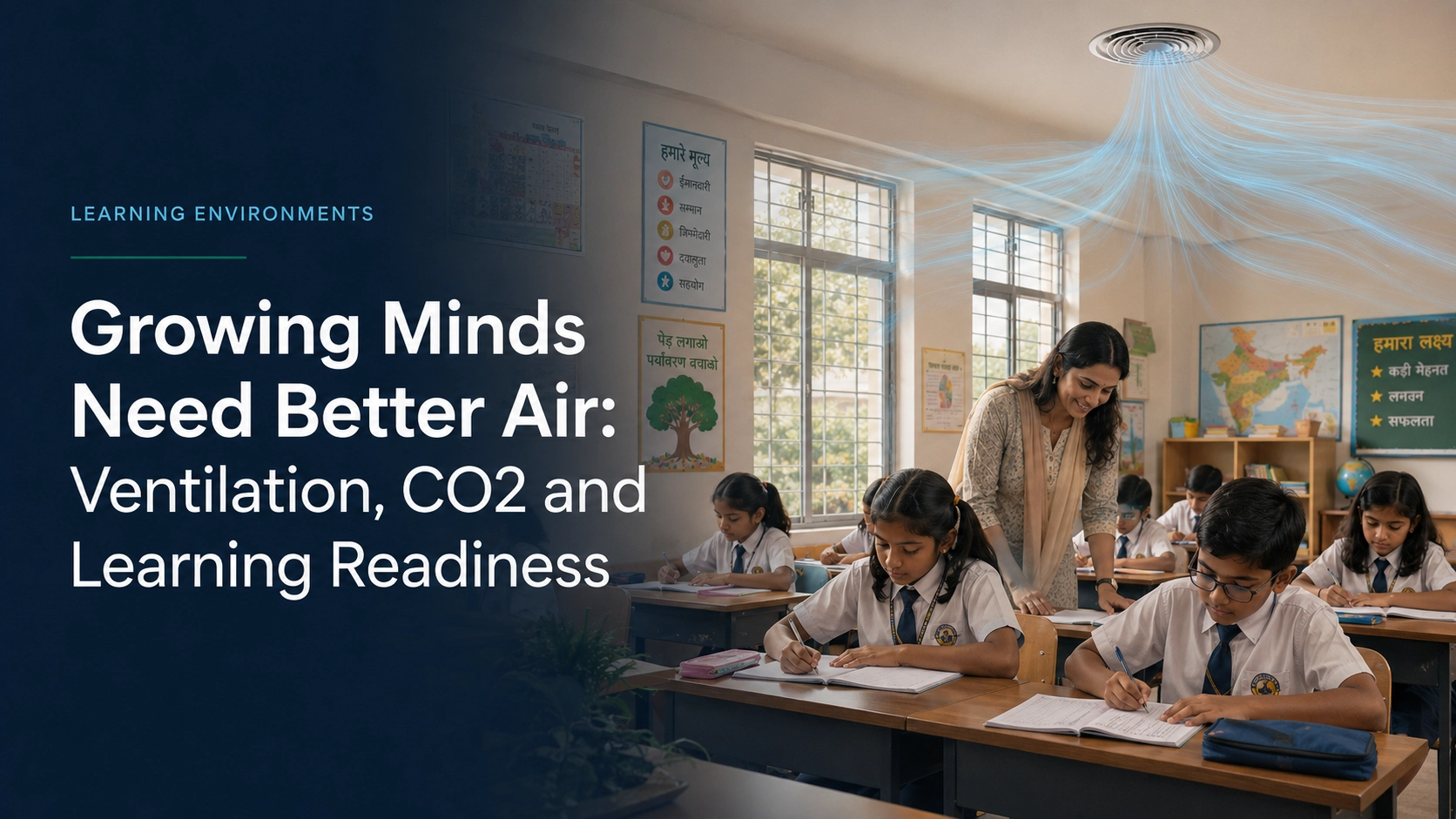
Growing Minds Need Better Air: Ventilation, CO₂ and Learning Readiness
Abstract: Children spend long hours indoors. This article explains why classroom ventilation matters, how CO₂ build-up can affect attention and comfort, and why fresh air should be treated as part of learning infrastructure — with specific attention to the conditions of Indian urban classrooms.
A good classroom is usually described in visible terms. It has enough desks. The board is clear. The lights work. The teacher is prepared. The walls may have posters. The room may have a projector, books, storage, and neat rows of chairs.
But a classroom is more than what we can see. It is also the air children breathe for hours.
Children spend a large part of their developmental years indoors. Classrooms, tuition centres, childcare spaces, libraries, activity rooms, and school transport all shape the conditions in which they learn, concentrate, interact, and grow.
When we discuss education infrastructure, we usually speak about teachers, technology, curriculum, seating, lighting, safety, and digital access. These are all important. But ventilation is rarely given the same attention. It should be.
Is this about oxygen deficiency in classrooms?
No — and that framing should be avoided. Most classrooms are not facing dramatic oxygen deficiency. That kind of language creates unnecessary alarm and is not the right way to discuss indoor air quality.
The more practical concern is ventilation. When many children sit in the same room for long periods, they exhale CO₂. If fresh air is not supplied adequately, CO₂ and other indoor pollutants accumulate. The room may still look clean. The fan may still be running. The AC may still be cooling. But the air may not be fresh enough for the occupancy.
CO₂ is useful because it helps indicate whether enough outdoor air is reaching the room. It is a practical signal — one that is measurable, interpretable, and directly tied to occupant density and ventilation performance. In classrooms, that signal matters.
Why are Indian classrooms particularly vulnerable to poor ventilation?
Classrooms in India face a convergence of conditions that make ventilation especially challenging.
Class sizes are large. A room designed for thirty students may hold forty or forty-five. Sessions run for extended periods — often fifty minutes to an hour and a half — with short breaks between. Buildings are sealed for thermal comfort: windows are closed to block heat, noise, monsoon rain, dust, and mosquitoes. Air-conditioning, where installed, is typically split-unit or cassette-type, which recirculates room air without a dedicated outdoor air intake.
In urban schools in Chennai, Bengaluru, and Mumbai, outdoor air pollution adds a further complication. Schools are understandably hesitant to open windows when outdoor PM2.5 is elevated, which it frequently is in areas adjacent to arterial roads. The instinct is correct — but closing classrooms without providing filtered fresh air replaces one problem with another.
In our IAQ assessments of schools and educational facilities, a consistent finding emerges: classrooms that are AC-cooled and window-sealed show CO₂ levels that cross 1,200 ppm within forty minutes of full occupancy. By the end of a ninety-minute session, levels in poorly ventilated rooms can reach 1,500–2,000 ppm. The room remains cold. The children remain seated. But the air has become progressively stale.
What does poor classroom air feel like to children?
Children may not describe poor air quality in technical terms. They may feel sleepy. They may become restless. They may lose attention. They may complain that the room feels hot, heavy, or uncomfortable even when the AC is running. Teachers may feel tired too — particularly toward the end of a long morning session in a room occupied continuously.
These signs can be mistaken for discipline issues, low interest, poor sleep, or screen exposure. Those may also be factors. But indoor air can contribute to the learning condition independently of all of them.
The EPA’s guidance on indoor air quality and schools notes that indoor conditions — including air temperature, humidity, ventilation, and pollutant levels — can affect student and teacher health, comfort, and the ability to concentrate. It also notes that students in classrooms with higher outdoor air ventilation rates tend to perform better on standardised assessments compared with students in poorly ventilated classrooms.
What is the learning readiness lens?
Learning readiness is the set of conditions — physical, cognitive, emotional — that allow a child to receive and process what a teacher is offering.
Teaching quality matters. Curriculum design matters. Emotional safety matters. But so does the physical environment. A child who is drowsy or uncomfortable in a poorly ventilated room is not learning at their best — regardless of how capable the teacher or how well-designed the lesson.
This is especially important because children have less control over their environment than adults. An adult in a stale meeting room can step out or open a door. A child usually stays where assigned. That gives schools a responsibility to understand classroom air quality more carefully than most currently do.
How does CO₂ monitoring help schools take action?
CO₂ monitoring does not solve ventilation problems by itself. But it reveals patterns that schools would otherwise have no way to see.
A school may discover that certain classrooms perform well in the morning but deteriorate after lunch, when afternoon sessions begin in rooms that have not been purged between uses. A room near a noisy road may show stronger CO₂ build-up because windows are kept closed more consistently. A small tuition room used back-to-back may become stale faster than a large hall with the same number of students per session.
ASHRAE’s position document on indoor CO₂ reinforces that CO₂ monitoring, interpreted responsibly alongside other IAQ indicators, is a practical tool for understanding ventilation conditions in occupied spaces. Applied to classrooms, this means monitoring during actual sessions — not in empty rooms — and comparing readings across different class sizes and session types.
Is classroom air quality an equity issue?
Yes — and this dimension is under-discussed. Schools with better resources tend to have better HVAC systems, more consistent maintenance, better filtration, and sometimes structured IAQ monitoring. Lower-resource schools may rely on natural ventilation, old ceiling fans, limited maintenance budgets, and higher occupancy ratios.
If air quality affects comfort, attention, absenteeism, or sustained learning capacity, then ventilation is part of educational equity. Every child deserves a classroom that supports learning. That includes air that is monitored, understood, and improved where needed.
In the Indian context, this equity dimension is sharper because the gap between well-resourced and under-resourced schools is wide, and because the environmental stressors — heat, humidity, outdoor pollution, monsoon moisture — are significant. A school with no budget for air quality monitoring may be systematically disadvantaging its students’ ability to learn in a way that goes unnoticed because the cause is invisible.
What questions should parents ask schools about ventilation?
Parents rarely ask about ventilation. That may be beginning to change as awareness of indoor air quality grows. Parents do not need to demand technical reports, but they can ask reasonable questions:
- How are classrooms ventilated, especially AC rooms that keep windows closed?
- Are filters in air-conditioning units maintained and replaced on schedule?
- Are CO₂ levels ever checked in densely occupied classrooms?
- Are rooms given time to refresh between back-to-back sessions?
- What is the plan during high outdoor pollution days — open windows or filtered fresh air?
What should architects consider when designing learning spaces?
Classroom ventilation should be addressed at the design stage — not resolved later through operational workarounds. A school building is not an office. Children have different use patterns, density ratios, and physiological sensitivities.
Architects and engineers should avoid designing learning spaces where thermal comfort depends on sealing the room without providing filtered fresh air. A classroom that uses split ACs without fresh air intakes is sealed by design. In Indian climate conditions — where windows remain closed for heat, rain, noise, or dust for much of the year — this creates a persistent IAQ problem that no amount of cleaning or thermostat adjustment will resolve.
Good design anticipates actual use. Planning for filtration, fresh air pathways, maintenance access, and real operating conditions at the design stage is far less costly than correcting it later.
How should school leadership approach IAQ practically?
School leaders do not need to become IAQ specialists. But they do need to treat air quality as part of school quality — the same way they treat fire safety, sanitation, and structural integrity.
A practical starting point:
- Measure representative classrooms during occupancy, not when they are empty
- Check rooms with high occupancy separately from lower-density spaces
- Review AC rooms with sealed windows as a specific category
- Review filter maintenance schedules and last replacement dates
- Collect structured teacher feedback on comfort and alertness patterns through the day
- Identify priority rooms based on occupancy density and complaint history
- Make low-cost operational changes first — purge periods, schedule adjustments, filter replacement
- Validate after correction with follow-up measurement
Does better air replace better teaching?
Fresh air will not replace good teachers. It will not fix poor curriculum. It will not solve every attention problem. It will not guarantee academic improvement by itself.
But it can support better learning conditions. Schools already invest in many things that support learning indirectly. Lighting does not teach a child, but poor lighting makes learning harder. Seating does not teach a child, but poor seating makes learning uncomfortable. Acoustics do not teach a child, but poor acoustics make it difficult to hear.
Air is no different. Fresh air does not teach — but it supports the conditions in which teaching and learning happen. That is enough reason to take it seriously.
FAQs
Is this about oxygen deficiency in classrooms?
No. The accurate concern is ventilation. CO₂ build-up indicates that fresh air is not keeping pace with occupancy — it does not mean oxygen is dangerously low. The distinction matters.
Can poor classroom air affect learning?
Poor air can contribute to discomfort, drowsiness, and reduced attention. It should be treated as one part of the physical learning environment, alongside lighting, acoustics, and thermal comfort.
Should schools install CO₂ monitors?
CO₂ monitoring is a practical tool for identifying classrooms that need ventilation review. It is especially useful in densely occupied, sealed classrooms where the problem is not visible without measurement.
Is opening windows enough?
Not always. In many Indian urban schools, outdoor pollution, noise, heat, and monsoon conditions limit window use significantly. Schools need a balanced approach that accounts for filtration, fresh air pathways, occupancy scheduling, and maintenance.
At what CO₂ level should a school be concerned?
ASHRAE uses outdoor CO₂ (approximately 400–420 ppm) as a reference baseline. Indoor levels consistently above 1,100–1,200 ppm during occupancy are a signal that fresh air is not keeping pace with the number of occupants in the space. This is a starting point for investigation, not a single definitive threshold.