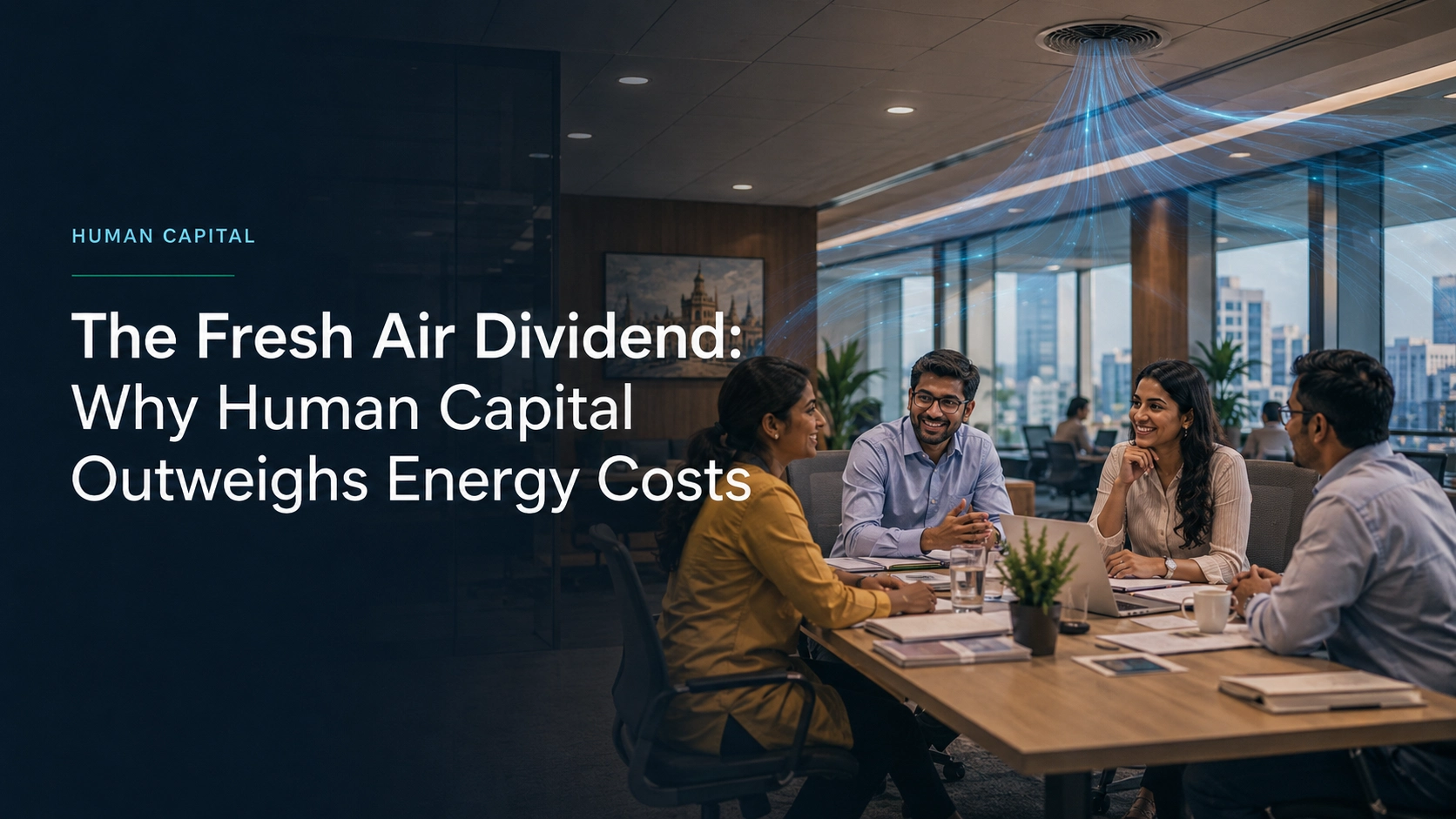
The Fresh Air Dividend: Why Human Capital Outweighs Energy Costs
Abstract: Building decisions focus on energy because it is metered and billed. This article makes the human capital case for ventilation — explaining how to value fresh air not as an operating cost but as a protection for the people inside — and offers a practical lens for decision-makers who manage both people and buildings.
The most valuable thing in a commercial building is not the building.
It is not the glass facade. It is not the HVAC system. It is not the lighting, furniture, interiors, or certification plaque.
It is the people inside.
This sounds obvious, but many building decisions do not reflect it. Energy is measured because it appears as a monthly bill. Equipment is maintained because breakdowns are visible. Indoor air quality — which shapes the daily experience of every person in the building — is often left unmeasured.
The fresh air dividend is the value created when buildings support people while using energy responsibly. It is not an argument for wasteful ventilation. It is an argument for intelligent ventilation — and for putting people back into the building performance equation.
Why does energy get more attention than people?
Energy is easy to manage because it is visible. There is a bill. There is a meter. There is a baseline. There is a target.
Indoor air quality is different. Unless it is measured, it remains abstract. The result is a structural bias in building management: decisions that can be metered get managed, and decisions that affect people are deferred until complaints become impossible to ignore.
This is not a question of bad intent. It is a question of what gets measured. The consequence is that fresh air is treated mainly as a load on the HVAC system rather than as a service to the people the building exists to support.
What does the human capital argument for fresh air actually look like?
In most office-based organisations, salary costs are far higher than utility costs.
In a 300-person office in a major Indian metro, a conservative estimate of annual people cost — salaries, benefits, employer contributions, recruitment, and management overhead — is in the range of ₹50–150 crore. The annual electricity bill for the same building, even at premium commercial tariffs, is typically ₹1–3 crore.
The ratio matters. When energy is 1–2% of people cost, optimising energy at the expense of occupant conditions is not a rational trade. It is a visible saving that hides a larger invisible cost.
What happens when ventilation is reduced to save energy?
Consider what happens in practice. A building reduces outdoor air intake during peak hours to lower cooling load. The thermostats remain stable. The rooms feel cold. But in meeting rooms and cabins, CO₂ rises progressively through the morning. By 11 AM in a continuously occupied boardroom, CO₂ may be at levels that most IAQ guidelines identify as a signal of inadequate fresh air. Occupants describe it as heaviness, tiredness, or difficulty concentrating — but they do not diagnose it as a ventilation issue because the room feels cold.
In our assessments across commercial office buildings in India, this pattern appears consistently: buildings that appear to be performing well from an energy standpoint contain indoor conditions that most occupants are simply tolerating rather than thriving in.
True efficiency is not the lowest possible energy use. True efficiency is the best balance between resource use and human outcome. These are not the same thing — and conflating them is expensive, just not in a way that shows up on the utility bill.
What do researchers say about ventilation and human performance?
ASHRAE’s position document on CO₂ in indoor environments establishes the relationship between CO₂ concentration and ventilation per person, and explains why CO₂ monitoring, interpreted carefully, is a practical proxy for whether ventilation is keeping pace with occupancy. It is a foundational document for anyone building an IAQ monitoring programme.
The World Green Building Council’s “Health, Wellbeing and Productivity in Offices” report synthesises a broad body of evidence and concludes that the indoor environment — ventilation, temperature, daylight, noise, and perceived control — is one of the strongest predictors of self-reported productivity in office settings. Occupants consistently rate air quality among their highest concerns when asked about workplace comfort.
The practical conclusion: if the building’s occupants are regularly naming air quality as a concern, that is not anecdotal noise. It is signal. Acting on signal before it becomes attrition, absenteeism, or return-to-office resistance is more economical than waiting.
What does the fresh air dividend actually include?
The fresh air dividend is not a single number. It is a set of benefits that accumulate across stakeholders and time horizons.
For occupants:
Comfort that does not require conscious management. A room that supports sustained attention. Meeting spaces that do not become cognitively heavier as the session progresses.
For facility teams:
A shift from complaint-reactive management to data-informed operation. Fewer unresolved service requests. More confident conversations about what needs to change and why.
For HR:
A workplace experience argument that is credible and specific. When employees describe the office as “fresh” and “well-managed,” that sentiment supports the return-to-office value proposition and the talent retention story.
For finance:
Protection of the organisation’s largest asset. A ventilation improvement that costs ₹10–30 lakh as a one-time project and reduces occupant discomfort even modestly is justifiable against a people base that costs hundreds of crore annually.
For ESG:
A data-backed indoor environment story. Measured, managed, and verified IAQ is more credible in sustainability disclosures than claims about “healthy workplaces” without supporting data.
What does a balanced ventilation strategy look like?
The answer is not to provide maximum fresh air at all times. In humid climates, excessive outdoor air increases moisture load. In polluted urban environments, outdoor air must be filtered properly. The right strategy is intelligent balance:
- Measure indoor air quality across representative zones
- Understand occupancy patterns and how ventilation demand varies through the day
- Verify that fresh air systems are actually operating, not just designed to operate
- Review filtration condition and replacement schedules
- Identify priority zones based on occupancy density, usage frequency, and complaint history
- Avoid unnecessary blanket interventions where specific corrections will suffice
- Validate improvements after correction with follow-up measurement
Why should HR own part of this conversation?
HR teams manage workplace satisfaction, wellness, retention, and employee experience. Yet indoor air quality is frequently absent from HR discussions — it lives in facilities, gets discussed in building management meetings, and rarely surfaces in people-strategy conversations.
Many workplace complaints have an environmental dimension. Tiredness, headaches, low energy, and reluctance to use certain rooms may not always be caused by workload or culture alone. Sometimes the space itself is contributing.
HR does not need to diagnose HVAC systems. But HR should be asking whether the workplace is being measured for comfort and air quality — and whether the answers are informing the people strategy. Air belongs in the healthy workplace conversation not as a facilities matter but as a people matter.
Why should finance sign off on IAQ projects differently?
Finance teams often approve or reject IAQ investments based on capital cost and energy payback. That frame is too narrow. The stronger financial view compares IAQ investment against the value of the people using the building — not just the energy cost of ventilating them.
Finance leaders do not need to become ventilation experts. They need to ask better questions:
- Are we measuring the indoor conditions that affect our people?
- Are our meeting rooms performing during occupancy, or degrading by mid-session?
- Are we saving energy in a way that compromises comfort?
- Can targeted improvements avoid larger future expenditure?
- Does better indoor air support the return-to-office investment we have already made?
These are business questions. They deserve business-level attention — from finance, not just from facilities.
FAQs
What is the fresh air dividend?
It is the value created when better ventilation supports comfort, alertness, workplace trust, and human performance while avoiding unnecessary energy waste. It is realised across occupant experience, facility operations, HR, finance, and ESG simultaneously.
Is energy efficiency less important than IAQ?
No. The goal is not to ignore energy — it is to avoid saving energy in a way that compromises occupant conditions. The two objectives are not inherently in conflict when ventilation is managed intelligently.
Who should own fresh air decisions?
Facilities should lead the technical work. HR, finance, sustainability, and leadership should be part of the investment decision. The business case cannot be made by facilities alone.
What is the best first step?
Measure representative spaces — especially meeting rooms, cabins, dense work zones, and high-use areas. Establish a baseline before investing. The data will direct the spending.